
Ancient cattle breeds
Hungarian cattle breeds – a living cultural heritage
Hungary is home to some of the world’s most unique and traditional livestock breeds. From the curly-haired Mangalica pig to the stately Hungarian Grey cow and the powerful water buffalo – these animals are not only important for meat, milk and charcuterie, but also carry centuries of history and culture. In this article, we explore their distinctive features, their use in Hungarian cuisine and how they are preserved as living heritage today.
During the 20th century, especially during the communist era and the Soviet occupation, Hungarian cuisine was affected by shortages and economic difficulties. Despite this, many traditional recipes and cooking techniques were preserved. Several of the ancient livestock breeds originating from Asia and almost extinct during the communist era have been restored. Among them is the Hungarian woolly pig Mangalica , Hungarian Grey Cattle and Water buffalo .


.jpg)
Hungarian Woolly Pig - Mangalica

Mangalica is a Hungarian woolly pig with curly fur that almost looks like sheep's wool. It was bred in the 19th century and is known for its marbled, flavorful meat and fine fat quality, making it appreciated both in traditional Hungarian charcuterie and by top chefs internationally.
Mangalica is a very hardy and robust breed that can handle outdoor living well. During the 19th century, the pigs were raised in the large oak and beech forests through so-called “acorn farming”.
In 1991, the Mangalica was close to extinction, with fewer than 200 breeding animals left in the world. Thanks to extensive conservation efforts, the number of breeding animals increased to over 7,000 in 2010.
Today, all Mangalica breeding in Hungary is continuously monitored by the National Association of Mangalica Breeders, which accounts for 95-98% of all present-day Mangalica pigs. The market is mainly in Hungary and Spain, where both Spanish and Hungarian products are produced completely without additives, according to traditional recipes and only from purebred animals. Therefore, the population and production can only be increased slowly in order not to compromise on quality.
The quality, taste and character of Mangalica meat
Mangalica meat is tender, juicy and very flavorful thanks to its high fat content. The fat is evenly distributed, giving the meat a rich and round flavor reminiscent of the quality of older, traditional cuts of meat. The meat has a natural sweetness and a nutty tone, perfect for slow cooking, grilling or smoked delicacies. The pork belly is extra flavorful and adds rich, aromatic flavors to sausages and other charcuterie.
Mangalica fat used in cooking as a base in stews or soups to elevate dishes to new heights and bring out the genuine Hungarian flavors. The fat is of high quality and has a low proportion of monounsaturated fats. This makes the fat a healthy, tasty and natural ingredient in Hungarian cuisine.
Hungarian Grey Cattle - Szürkemarha

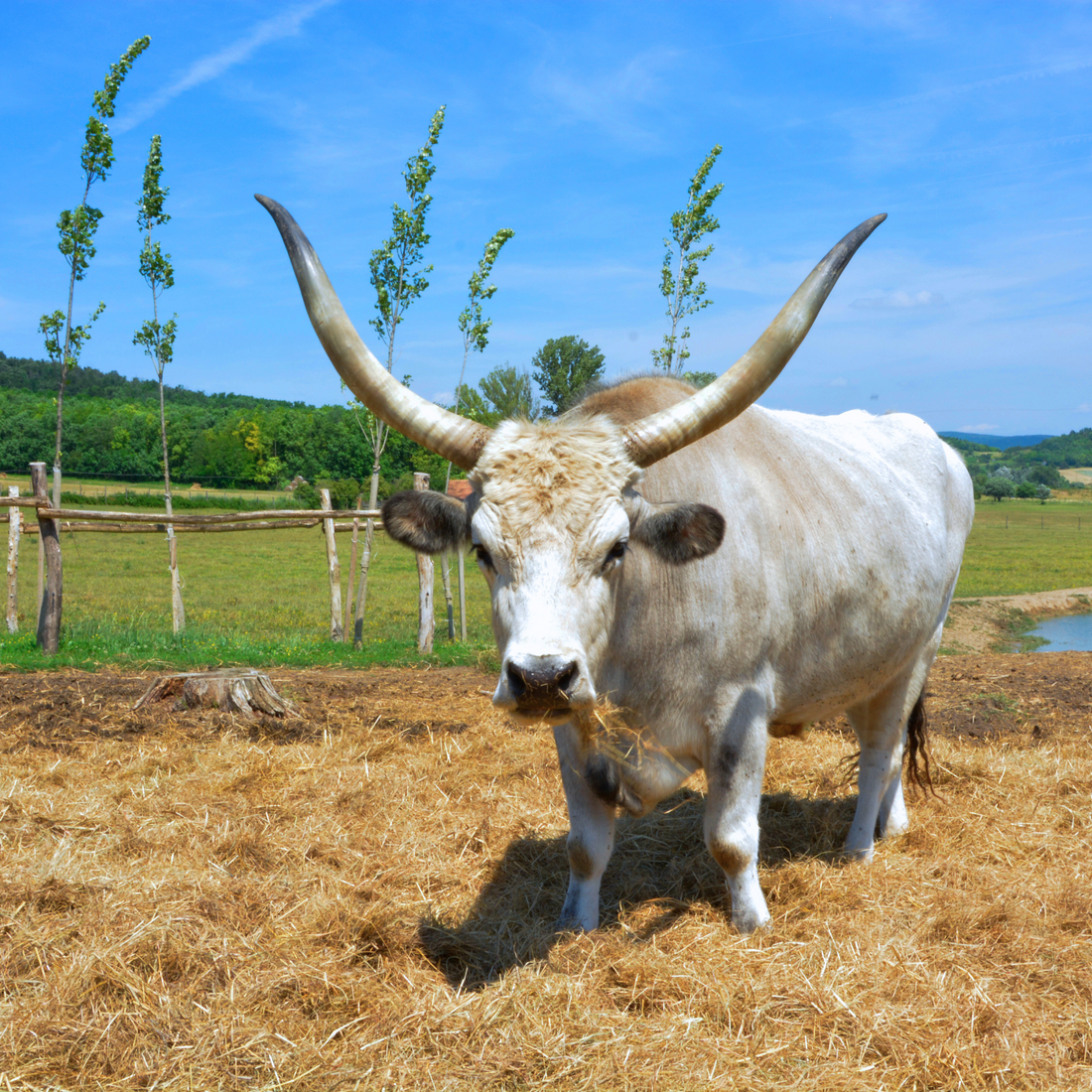
Hungarian Grey Cattle is one of the country's oldest cattle breeds and is characterized by its long, elegant horns and resistance to harsh climates. Its meat is lean and aromatic and is considered a delicacy, often associated with traditional stews and soups.
A legally protected breed of cattle native to Hungary, it is a symbol of the Hungarian Puszta, the Great Plain, and with its stately stance, silver-gray color, and powerful horns, it is one of the country's most recognizable animals.
The Hungarian Grey Cow has been present in the Carpathian Basin for centuries. Between the 13th and 18th centuries, it was one of the leading meat producers in Central Europe. Every year, tens of thousands of animals were driven on foot to markets across Europe.
From decline to preservation
After World War II, the number of grey cows decreased drastically. The mechanization of agriculture made draft animals redundant, and by the 1960s there were only a few hundred animals left in the entire country.
Thanks to dedicated conservation efforts, the breed has recovered. Since 2011, it has EU Protected Designation of Origin (PDO) , which guarantees its authenticity and unique geographical origin. The Association of Breeders of the Hungarian Grey Cow carefully checks the origin – meat and products from these animals are DNA tested to ensure authenticity.
Features
The Hungarian gray cow is strong, hardy and adapted to life on the open plains.
- Cows usually weigh 550–600 kg, bulls 700–900 kg
- The color varies from silver gray to dark gray
- Calves are born red or hazelnut brown and turn gray at 6–8 months of age
- The bulls develop a darker, almost black color on some parts of their bodies as they get older.
The breed is known for its resilience and natural lifestyle. It lives out on pasture from April until the first snow, without concentrates or supplements. During the winter, the animals are fed hay and straw. Thanks to their natural diet, the meat is completely BSE-free and highly valued in Europe for its pure taste and quality.
A living legacy
Today there are around 2,500 Hungarian Grey cows in Hungary. In addition to their role as livestock, the breed has gained new significance as part of ecotourism and cultural heritage. Many farms proudly display their Grey cows as a symbol of tradition, strength and the balance of nature.
The Hungarian Grey Cow is more than an animal – it is a living legacy of the Hungarian people. The countryside, a link between history and the present.
Hungarian Water Buffalo

The Hungarian water buffalo has long been used as a draft animal, but today it is primarily its milk that is valuable. The fatty and protein-rich buffalo milk is used, among other things, to produce cheeses and yogurt with an intense flavor.
In Hungary it is called Hungarian water buffalo or domesticated water buffalo . The ancestor of the domesticated Hungarian water buffalo was probably the Indian wild buffalo, the arni buffalo. It probably came to the Carpathian Basin as a draft animal during the Migration Period. Its strength is almost incredible: two water buffalo calves are equivalent in strength to four grey cattle oxen. During the Turkish Wars, buffaloes were used by the Turkish army to pull cannons thanks to their enormous draft power, which also contributed to their spread.
The water buffalo is extremely easy to care for and hardy. It grazes on reeds, reeds and marsh grasses and thrives particularly in damp, marshy areas. It has a slow gait but can run surprisingly fast when needed. Its sound is a cross between a bellow and a grunt. Both cows and bulls have a typical dark brown to black color.
The Hungarian domestic water buffalo is found mainly in Transylvania and southern Transdanubia, but also in other parts of the country, such as Homokhátság, Mezőtúr and Hortobágy. They are usually kept by private individuals or small breeders.
The taste and character of the meat
Buffalo meat is dark, flavorful and slightly higher in fiber than beef. It has a natural sweetness and is rich in iron and phosphorus, making it extra nutritious. In Hungary, the meat is used in traditional dishes such as slow-cooked stews, stews and sausages, but also in more festive dishes where the full flavor really takes center stage. Buffalo meat is excellent for smoking, frying and slow cooking, as the fat gives it a juicy and aromatic flavor.
Use of buffalo milk
Buffalo milk is fatty and creamy, with a higher nutritional content than cow's milk. It is mainly used for mozzarella and other fresh cheeses, but also for yogurt and traditional Hungarian desserts. Thanks to its full flavor and high fat content, the milk gives a round and rich texture that is appreciated in both cooking and baking.
Tradition and modern use
In modern-day Hungary, buffalo meat and milk can be found both in local farm shops and in specialized restaurants. The products are often used according to traditional recipes, preserving the authentic taste and connecting to the country's culinary heritage.
Magyar Racka-Juh - Hungarian sheep

The Magyar Racka-juh is an ancient Hungarian sheep breed known for its characteristic, spiral horns and hardy temperament. The breed has been preserved in Hungary for hundreds of years and is valued for its meat, wool and as part of its cultural heritage. The Racka sheep is particularly adapted to harsh climates and barren landscapes, making it easy to care for and resistant to disease. Its wool is long, coarse and ideal for traditional crafts, while its meat is lean and flavorful. In addition to its practical advantages, the Magyar Racka-juh has an impressive appearance, making it popular in both agriculture and agritourism.
Hortobágy – the heart of the Hungarian Puszta
Hortobágy is one of Hungary's most iconic places, located in the vast puszta in the eastern part of the country. The area is not only a unique nature reserve with vast grasslands and rich wildlife, but also a living part of Hungary's cultural heritage. Hortobágy has long been a center of traditional livestock farming, especially with sheep and horses. Many of the old pastoral cultures still survive today.

Hortobágy also plays a central role in Hungarian culinary culture. The region is known for its traditional dishes, such as the hearty Gulyás, Pörkölt and the famous Hortobágyi palacsinta, filled pancakes with meat in a rich sauce. Many of these dishes are directly inspired by the pastoral lifestyle and the ingredients that the Puszta offers.
With its combination of nature, tradition and food culture, Hortobágy is well worth a visit!